

Sara Landry is the most consequential figure in hard techno right now, and the trajectory that got her here reads like a case study in what happens when raw talent collides with a cultural moment. In roughly three years, she went from producing tracks in her bedroom to headlining Ultra Miami, building her own label, and becoming the gateway through which an entire generation of young ravers discovered the harder end of electronic music. This is not just an artist profile. This is the story of a genre reaching critical mass, and the woman who lit the fuse. Explore our full collection of festival clothing for more festival-ready styles. Shop all festival clothing handcrafted in San Diego.
Hard techno is the fastest-growing electronic subgenre on the planet, and Landry sits at its center not as a figurehead but as an architect. Her debut album, her label HEKATE, and her relentless touring schedule have collectively redrawn what a career in techno looks like. To understand where the scene is headed, you have to understand what she built and why it resonated.
From Bedroom Producer to Global Headliner
Sara Landry's rise defies the traditional techno timeline. In a genre where artists typically spend a decade grinding through residencies and white-label releases before reaching headliner status, Landry compressed that arc into three years. The catalyst was not a single track or a well-placed remix. It was the collision of her uncompromising sound with TikTok's appetite for visceral, high-impact content.
Her DJ sets — relentless, punishing, technically precise — became viral material on a platform that rewards intensity. Clips of her mixing hard techno at 145 BPM to rooms losing their collective composure accumulated millions of views. But viral attention is easy to squander. What separated Landry was that the substance matched the spectacle. People came for the clips. They stayed because the music was genuinely exceptional.
By 2024, she had graduated from club bookings to festival main stages. By 2025, she was selling out headline shows across Europe and North America. And now, in 2026, she is headlining Ultra Miami in a b2b set with Amelie Lens — a booking that would have been unthinkable for a hard techno artist five years ago. The speed of that ascent tells you something important: the audience was already there, waiting for someone to give them permission to go harder.
Spiritual Driveby: The Album That Changed Hard Techno
When Sara Landry released Spiritual Driveby in October 2025, it landed as more than a debut album. It landed as a statement of intent for an entire subgenre. Hard techno had spent years being dismissed by purists as one-dimensional — all aggression, no artistry. Spiritual Driveby dismantled that critique track by track.
The album is brutal in places, yes. There are moments of unrelenting 145 BPM fury that would reduce a concrete floor to rubble. But there are also stretches of atmospheric tension, industrial texture, and melodic restraint that reveal an artist thinking far beyond the four-to-the-floor template. Landry produced the entire record herself, and the production quality stands with anything coming out of the Berlin or Amsterdam techno establishments.
What makes Spiritual Driveby significant beyond its sonic qualities is what it proved commercially. Released on her own label HEKATE rather than through an established imprint, it demonstrated that hard techno could sustain a full-length album cycle — with press, touring, and a global audience — entirely on independent terms. That model did not exist in hard techno before she built it.
The album title itself captures something essential about Landry's approach. There is a spiritual dimension to the music that coexists with its aggression. The tracks are designed to induce a trance-like state through repetition and intensity, the same way industrial and noise artists have pursued catharsis through volume for decades. It is music that works on your body first and your mind second, and the album format gives it room to breathe in a way that standalone singles never could.
HEKATE: The Artist-as-Ecosystem Model
Sara Landry's HEKATE is not just a record label. It is a label, a booking agency, and a brand rolled into a single entity — an entire ecosystem built around one artist's vision. In an industry where the traditional model separates these functions across different companies with competing interests, Landry collapsed them into a unified operation that she controls entirely.
This matters because it represents a new blueprint for how electronic artists can build sustainable careers. Rather than licensing her music to a label that takes a cut, booking through an agency that takes another cut, and building a brand through third-party partnerships that dilute her vision, Landry owns every piece of the pipeline. HEKATE releases the music, books the shows, and cultivates the visual and cultural identity. The margin stays with the artist.
The HEKATE stage takeover at Ultra Miami 2026 is the most visible proof of concept. When Landry takes the stage on March 27 for her b2b with Amelie Lens, it will not be as a guest on someone else's platform. The stage itself carries the HEKATE brand. She is not performing at Ultra so much as she is embedding her own infrastructure within it. That distinction is subtle but significant — it signals that HEKATE has enough gravitational pull to command its own real estate at the world's biggest electronic music festival.
For aspiring producers and DJs, HEKATE is a template. It suggests that the future of electronic music careers may not run through the established label system at all, but through artist-owned verticals that consolidate creative control and economic value under one roof.
Hard Techno's Audience and the Cultural Shift
The most interesting thing about hard techno's rise is who is driving it. The audience skews younger and more female than techno's traditional demographic, and that is not incidental. It is the story. A generation of young women who entered dance music through melodic house, progressive, or bass music are gravitating toward harder, more aggressive sounds — and finding empowerment in music that the culture told them was not for them.
Sara Landry is central to this shift, not because she set out to market to women, but because her presence at the front of the movement normalized something that needed normalizing. A woman producing, performing, and running the business side of the hardest music in electronic dance culture. No qualifiers, no novelty framing. Just the work and the results.
The cultural implications extend beyond music. Hard techno's audience is rejecting the soft, accessible aesthetic that dominated festival culture for a decade. The sound is abrasive. The fashion is dark. The energy is confrontational. And the fact that young women are leading this charge upends the assumption that harder always means more masculine. It does not. It means more intense, and intensity is not gendered.
This audience overlap is precisely why the hard techno movement matters to rave fashion. The women filling out Landry's sets are not shopping for pastel butterfly wings and flower crowns. They are looking for dark rave outfits that match the energy of the music they are consuming: structured, aggressive, unapologetically hard. The fashion is evolving in lockstep with the sound.
What to Wear to a Hard Techno Set
Hard techno fashion is a language, and it says something different than what you wear to a house music pool party or a trance sunrise set. The aesthetic pulls from industrial, goth, and Berlin club culture — all black, architectural silhouettes, and hardware that catches the light in a dark room. If melodic house dresses for the golden hour, hard techno dresses for the 3 AM warehouse.
The All-Black Foundation
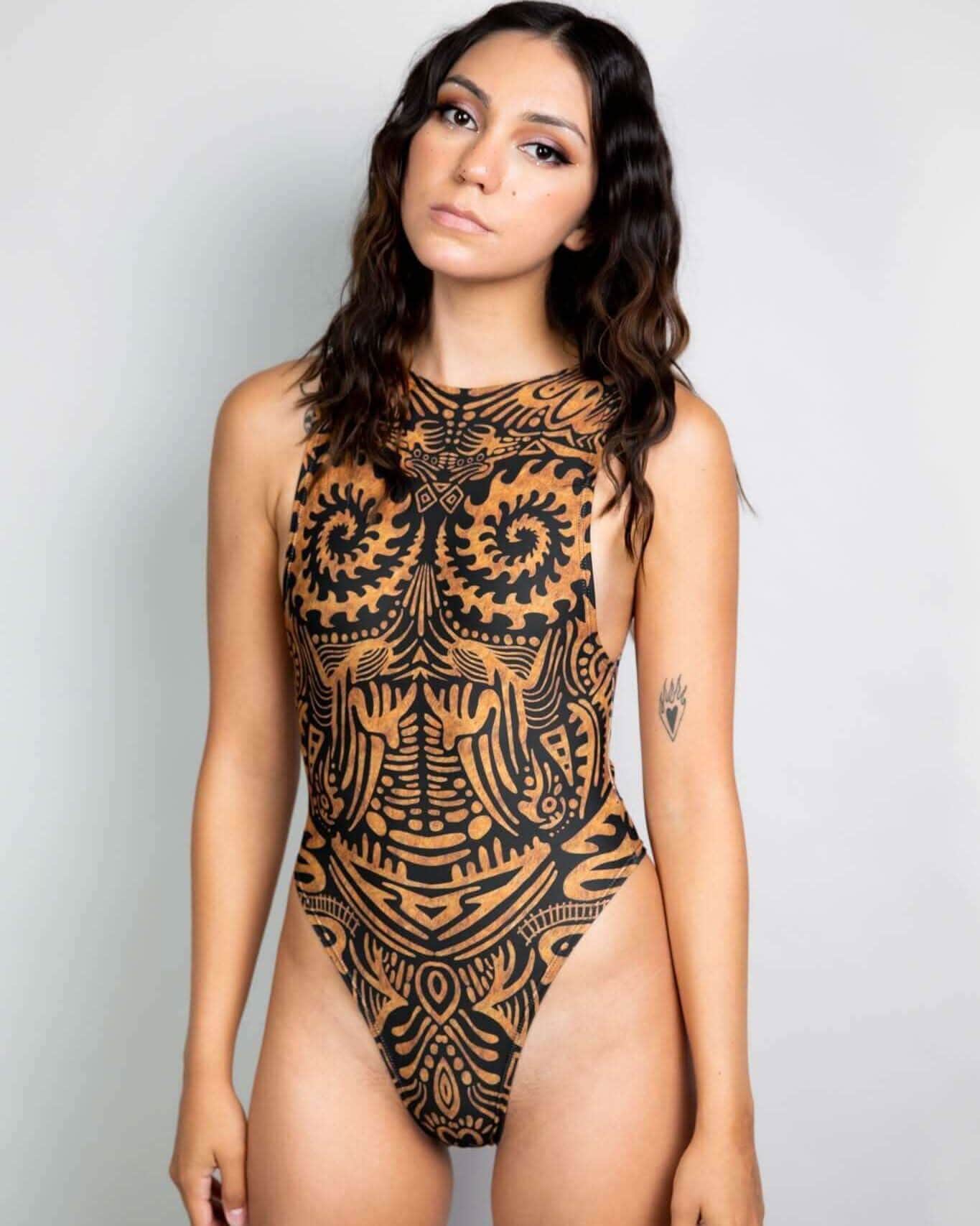
Start with black. Not as a default, but as a statement. At a hard techno event, an all-black outfit is not boring — it is fluent. Matte black rave wear reads as intentional in this context: fitted bodysuits, structured crop tops, and high-waisted bottoms in fabrics that absorb light rather than reflecting it. The goal is a silhouette that looks sharp under minimal lighting and moves cleanly through a dense crowd.
Texture is what differentiates one all-black look from another. Mesh panels, ribbed knits, matte versus gloss finishes, and strategic cut-outs create visual depth without introducing color. The best hard techno outfits look monochrome from a distance but reveal layers of detail up close.
Chains, Harnesses, and Hardware
Chains and harnesses are not accessories in hard techno — they are architecture. A body harness layered over a black bodysuit transforms the silhouette entirely, adding structure and edge that soft fabrics alone cannot achieve. Chain belts, O-ring chokers, and metallic hardware reference industrial and fetish aesthetics that have been part of techno's visual vocabulary since the genre's earliest days in Detroit and Berlin.
The key is restraint. One well-chosen harness or a single chain detail does more work than layering every piece of hardware you own. Hard techno fashion rewards precision over excess. Think of it the way Landry thinks about her sets: every element is there for a reason, and nothing is decorative.
Footwear and Finishing Details
Platform boots and chunky combat boots are the standard. You will be standing on concrete for hours, so cushioning matters, but the elevated sole also provides better sightlines in packed venues. Matte black leather or vegan leather finishes keep the look cohesive. Avoid anything too clean or polished — hard techno boots should look like they have been to a few warehouses.
For finishing details, keep makeup graphic and minimal. Dark lips, sharp liner, and matte skin read well under UV and strobe lighting. Skip glitter and shimmer — that belongs to a different genre entirely. The overall impression should be deliberate and slightly severe, like you dressed for war and the battlefield happens to have a sound system.
Where to See Sara Landry in 2026
Landry's 2026 touring schedule reflects both her reach and the global appetite for hard techno. The year's marquee moment arrives at Ultra Miami (March 27-29), where she headlines b2b with Amelie Lens alongside a HEKATE stage takeover. That booking alone would define most artists' year. For Landry, it is the opening statement.
She follows Ultra with a European run that includes Mannheim (March 21), Edinburgh (April 18-19), Barcelona (June 18-20), Tomorrowland in Belgium (July 17-26), and Budapest's Sziget (August 11-15). On the North American side, she plays Coachella's Quasar Stage Weekend 2, Lightning in a Bottle (May 20-24), Movement Detroit (May 23-25), a Washington DC date (May 30-31), and Bonnaroo (June 11-14).
For the full itinerary and ticket links, check her Sara Landry tour dates page. Shows are selling out faster than in previous years, which tells you everything about where the demand curve is headed.
If you are attending any of these dates, particularly Ultra or Coachella, plan your wardrobe around the energy of the set you are walking into. A Sara Landry show is not a passive listening experience. It is a physical event. Dress for movement, dress for intensity, and dress like you understand what the music is asking of you.
Why This Moment Matters
Hard techno existed before Sara Landry, and it will exist after her. But this specific moment — where the genre crosses from underground credibility into mainstream festival headliner status — is happening on her watch and largely because of her work. Spiritual Driveby gave the genre its first album-length artistic statement. HEKATE gave it an independent business model. And her touring schedule is putting hard techno in front of audiences who had never been exposed to it.
The Amelie Lens b2b at Ultra is the watershed. Two women headlining the world's biggest electronic music festival with the hardest music on the lineup is not something that gets footnoted in dance music history. It rewrites the assumptions about what headline-level electronic music sounds like, who makes it, and who shows up to hear it.
The audience that Sara Landry built is not going back to softer sounds. They found something in hard techno that melodic genres were not giving them — catharsis, power, a physical relationship with music that does not apologize for its intensity. That audience is young, it is growing, and it is reshaping festival culture from the inside out. The fashion, the bookings, the label structures, and the cultural conversation are all shifting to accommodate what hard techno demands. And at the front of that shift, producing the records, running the label, and playing the sets that started it all, is one artist who decided three years ago that the underground did not have to stay underground.